
Lihat juga


 16.10.2026 11:54 AM
The dollar eased after remarks by Fed chair Kevin Warsh, who gave the market neither a clear signal of further hikes nor a hint of an imminent pause. The currency reacted as it does to the absence of confirmation for the most aggressive expectations. Investors who, after the inflation prints, expected a more belligerent tone instead heard a rejection of a pre-committed path.
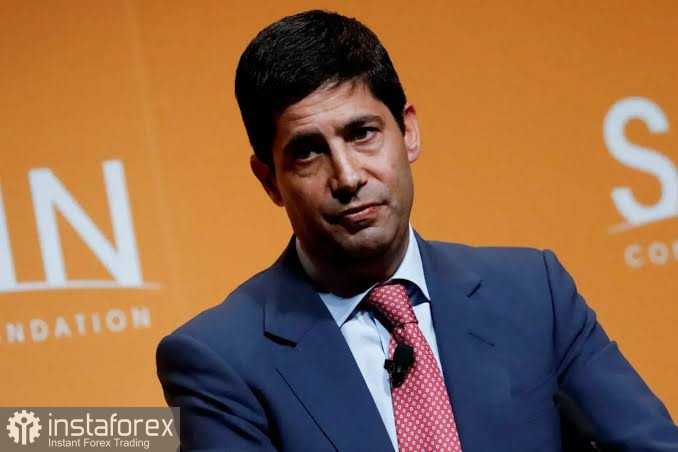
The main point of his remarks was that the Fed will not pre-announce future rate decisions. Warsh clarified that decisions will be evaluated at the October and December meetings—he therefore left both dates open. That is a material departure from the prior practice of preparing the market in advance, and it differs from the more cautious messaging of officials such as John Williams and Philip Jefferson in September. Now the market will have to assess each meeting on its own, which increases uncertainty and reduces the value of any rate path forecasts.
The second important theme was financial stability. Warsh said the Fed must weigh risks to stability and acknowledged he may be overly sensitive to the legacy of the global financial crisis. "I may be too sensitive to the consequences of the global financial crisis," Fed chair Kevin Warsh said. In my view that line was the most important for the dollar because it signals the central bank's readiness to approach tightening more cautiously if systemic risks accumulate. Risk assets and currencies competing with the dollar benefit from that stance, while the dollar—whose appeal rests partly on expectations of an aggressive Fed—loses ground.
Warsh's global assessment is also telling. He noted that since the September meeting the world has broadly evolved as expected and that monetary policy is tightening simultaneously across jurisdictions. Inflation, he said, is not only a US problem but a global one. For FX markets this means the policy gap between the Fed and other central banks is unlikely to widen as much as dollar bulls had hoped. If the ECB reads a December hike and the Bank of England and the Bank of Japan also tighten, the US rate advantage narrows, supporting the euro, the pound, and the yen.
In the economy, Warsh sounded relatively upbeat. He spoke of structural growth and said investment has risen sharply. He expects AI to raise productivity, but he cautioned the technology's initial impact will appear on the demand side. That is an important nuance: demand for AI infrastructure first pushes prices up, while productivity gains come later. This echoes Austan Goolsbee's prior warning about overheating, so Warsh's comments cannot be called dovish. The Fed will also hold in-person hearings on AI on November 16, underscoring how seriously the bank treats the factor.
Recall consumer inflation in September hit 3.7%, with core at 2.6%, while producer prices rose 1.3% for the month and 6.3% year-on-year. Markets price about 40 basis points of hikes by the end of January and nearly full odds of a December move, with low odds for October. Against that backdrop, Warsh could have strengthened hawkish rhetoric but did not, and that is why the dollar lost its footing. I believe the chair deliberately preserved flexibility rather than tying the Fed to commitments to the market.
My forecast is as follows. The October 27–28 meeting will most likely end in a pause, and the decision on a December hike will depend on incoming data; the probability of a step remains high because of inflation. But without explicit commitments from the Fed, the market will be more willing to pare back bets on aggressive tightening in 2027, and the dollar will remain under pressure versus the euro, the pound, and the yen. The main risk to this scenario is another run of strong inflation readings that would push the central bank back toward firmer signaling; for the euro, the situation in France remains an important variable.
Technical picture for EUR/USD
Buyers now need to think about reclaiming 1.1241. Only that would allow targeting a test of 1.1275. From there, one can reach 1.1310, but doing so without support from large players will be difficult. On the downside, I expect serious buying only around 1.1193. If nobody appears there, it would be sensible to wait for a new low near 1.1156 or to open longs from 1.1117.
Technical picture for GBP/USD
Pound buyers need to take the nearest resistance at 1.3310. Only that would allow targeting 1.3340; breaking above that will be fairly difficult. The far target is the 1.3370 area. On a decline, bears will try to seize control of 1.3275. If they succeed, a break of the range would deal a serious blow to bulls and push GBP/USD to a low near 1.3230 with scope to reach 1.3200.


