
یہ بھی دیکھیں


 16.10.2026 08:36 AM
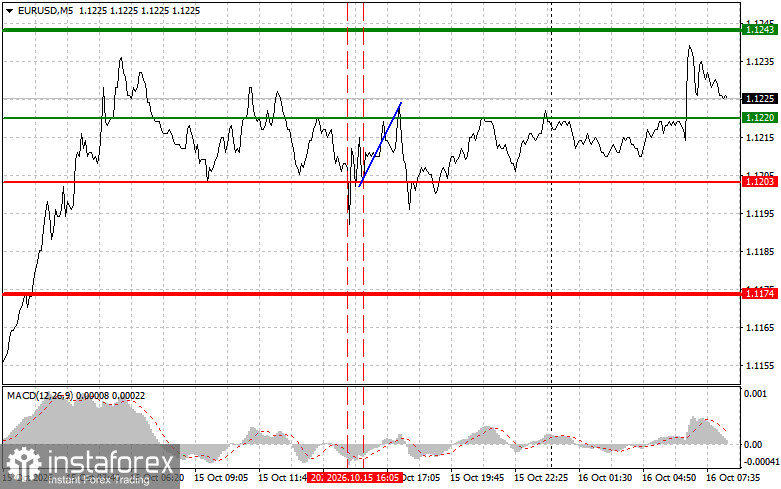
A price test at 1.1203 occurred after the MACD indicator had already moved far below the zero line, limiting the pair's downside potential. A second test of 1.1203 triggered Buy Scenario 2 and resulted in a 20-pip rise.
The euro weathered strong US data without serious losses — and that is an important signal. The dollar got only temporary support and lacked the strength to push harder against the single currency, even though the US prints were strong. US PPI for September rose 1.3% month-on-month versus a 0.5% forecast (and 0.5% in August) — the strongest monthly increase since March 2022. Core PPI gained 0.7% versus 0.3% expected, and retail sales rose 0.8% versus 0.3% expected. This package makes a December Federal Reserve hike more likely, but the market had long priced it in, so the reaction was muted.
Today EUR/USD depends on whether final eurozone inflation figures match the preliminary estimates. The first estimate showed September eurozone CPI at 3.8% year-on-year versus 3.2% in August, which is why the market has penciled in a final European Central Bank hike to 2.75% in December. The deposit rate is currently 2.50%, and the next meeting is October 29. Christine Lagarde has said energy will keep prices elevated into the first half of 2027, and September's 18.8% jump in energy fits that thesis.
If the final data are revised higher, the euro should continue to rise — a realistic scenario given Germany's September CPI of 3.3% versus 2.9% in August and a 1.9% monthly jump in producer prices. The headline CPI will show whether price pressure has become persistent, and the trade balance will indicate external demand.
For intraday strategy, I will mainly rely on Scenarios 1 and 2.
Scenario 1: Buy the euro today near 1.1236 (green line on the chart), targeting 1.1269. I plan to exit at 1.1269 and also open short positions there, aiming for a 30–35 pip retracement from the entry. Expect euro gains today only after strong European data. Important: before buying, ensure MACD is above zero and only beginning to rise from it.
Scenario 2: Also consider buying if price tests 1.1215 twice while MACD is in the oversold area. That would limit downside potential and trigger an upward reversal. Expect moves to 1.1236 and 1.1269.
Scenario 1: Plan to sell the euro after it reaches 1.1215 (red line on the chart). Target 1.1188, where I will exit short positions and immediately open long positions (aiming for a 20–25 pip reversal). Strong renewed pressure on the pair could return at any time. Important: before selling, ensure MACD is below zero and only beginning to fall from it.
Scenario 2: Also consider selling if price tests 1.1236 twice while MACD is in the overbought area. That would limit upside potential and trigger a reversal downward. Expect declines toward 1.1215 and 1.1188.
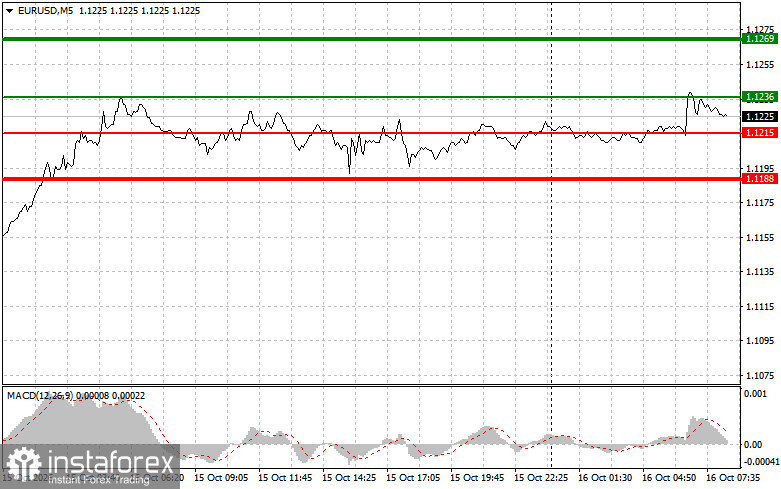
Thin green line — entry price where you can buy the instrument.
Thick green line — approximate price where you can place Take Profit or manually lock in profits, because further upside above this level is unlikely.
Thin red line — entry price where you can sell the instrument.
Thick red line — approximate price where you can place Take Profit or manually lock in profits, because further downside below this level is unlikely.
MACD indicator. When entering the market, it's important to consider overbought and oversold zones.
Important. Novice Forex traders must be very cautious when deciding to enter the market. It is best to stay out before major fundamental reports to avoid getting caught in sharp price swings. If you decide to trade during news releases, always place stop orders to minimize losses. Without stop orders, you can quickly lose your entire deposit, especially if you don't use money management and trade large volumes.
Remember: successful trading requires a clear trading plan, like the example above. Spontaneous trade decisions based solely on the immediate market situation are, by definition, a losing strategy for an intraday trader.


