
یہ بھی دیکھیں


 09.10.2026 09:13 AM
Oil eased after Donald Trump said the US would not strike Iran before the midterms, and Brent fell below $103/bbl. The December contract lost 1.3% to $102.94, while WTI for November delivery dropped 1.2% to $90.37. Brent had jumped more than 4% the day before, so the current pullback only partially reverses Thursday's spike.
The market read the signal as a pause spanning more than three weeks without offensive action against Tehran. In a social-media post, the president referred to "productive" talks with Iran but gave no details, and he stressed that the naval blockade of Iranian ports remains fully in place. The vote is set for November 3, control of Congress is uncertain for the Republicans, and rising pump and diesel prices are a major voter concern. For that reason, I see this decision as more of a domestic political calculation than a change in policy toward Iran.
A notable figure Trump cited was that some 22 million barrels passed through the Strait of Hormuz overnight — more than typical pre-war daily flows. He gave no evidence, and that estimate is higher than recent industry figures: Vitol's CEO mentioned about 12 million b/d, while U.S. Central Command cited about 20 million. The divergence between official and industry numbers—almost two-fold—helps explain why traders are reluctant to believe in a full restoration of flows.
The situation at sea is not calming. Iran continues attacks in the strait, and Fars agency reported several loud explosions in Hormuz late Thursday as tankers took the southern route and struck mines — the report lacks independent confirmation. UKMTO counted nine attacks in the strait since the start of October.
Freight costs have also become a standalone factor. Shipping oil from the Persian Gulf to East Asia now costs more than six times what it did before the conflict, and this record surge adds huge costs across the supply chain. That raises refinery feedstock costs even when futures are stable, with the burden ultimately passed to diesel and gasoline consumers. Renewed fighting between Saudi forces and Iran-aligned Houthis in Yemen adds further uncertainty.
Another risk lies in the Gulf of Mexico. Hurricane Isaias is strengthening and is expected to make landfall in the US late Friday or early Saturday, threatening Alabama, Mississippi and northern Florida. Producers have already shut down about 1.3 million b/d — more than 60% of regional output.
My view: Brent should trade roughly in a $98–$106 range in the coming sessions, and the main directional risk is upside — a hurricane, mines in Hormuz, or statements from Washington could push the price above $105 within a day. A sustained close below $100 looks unlikely before November 3; a downside move will most likely find support at that psychological level.
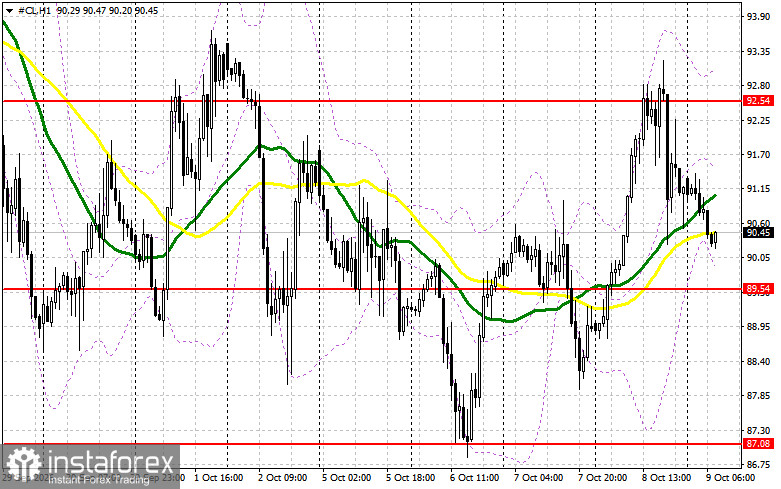
Technical picture for oil: buyers need to take the near resistance at $92 to target $96, above which a breakout will be difficult. The far target is the $100 area. On the downside bears will try to seize $89; if they succeed, a range break would seriously damage bull positions and push oil toward $87 with a prospect of reaching $83.


